Research
My research is organised around five connected themes. Select a theme in the ringlist to go to its section, with key papers, software and related projects.
- Understanding the assembly of communities and biotic interaction networks
- Mechanisms behind biodiversity patterns in macroecology and macroevolution
- Systems ecology and process-based simulation models
- Model-data integration, simulation-based inference and Bayesian statistics
- Statistics, machine learning and deep learning in ecology
Understanding the assembly of communities and biotic interaction networks
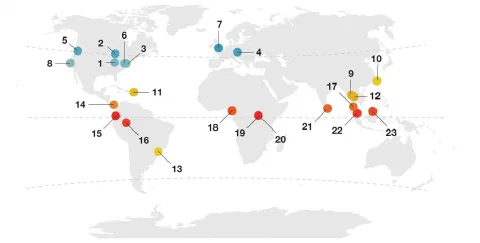
Why do so many species live side by side, and what decides which of them occur together? It depends on how species interact, through competition, predation or pollination, but also on the environment, on dispersal and on chance. The question matters in practice, because interactions influence how the loss or arrival of a species spreads through a community. Yet interactions and the other influences leave similar traces in the data, so they are hard to tell apart. New data sources such as environmental DNA, combined with joint species distribution models that analyse whole communities, can help to separate them. With my group, I study density dependence and trait matching, two ways in which interactions shape communities, and work on these community models.
Key papers: Hülsmann et al. 2024, Nature; Hülsmann et al. 2021, Trends in Ecology & Evolution; Hartig et al. 2024, Trends in Ecology & Evolution. Software: sjSDM. Projects: sCOM.
Mechanisms behind biodiversity patterns in macroecology and macroevolution
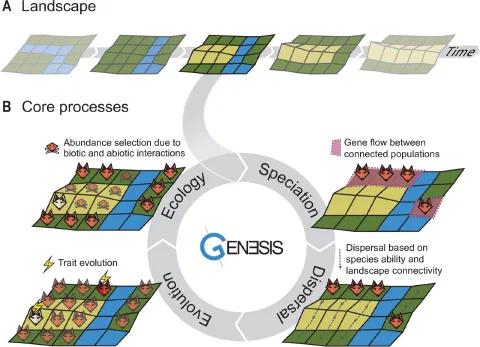
Across the globe, biodiversity follows strikingly regular patterns. The best known is that species richness generally rises from the poles towards the equator. Such patterns show where biodiversity is concentrated, which makes them important for conservation. Proposed explanations include differences in speciation and extinction, in the time available for species to accumulate, and in how many species a region can support, and they need not exclude one another. Models built on several of these explanations can reproduce the gradient, so this one pattern cannot tell them apart. The models therefore have to be tested against many patterns at once, from range sizes to the shape of phylogenies. With my group, I work on eco-evolutionary simulation models for such tests and fit diversification models to phylogenies.
Key papers: Pontarp et al. 2019, Trends in Ecology & Evolution; Hagen et al. 2021, PLOS Biology; Morlon et al. 2022, Trends in Ecology & Evolution. Software: gen3sis. Projects: sELDiG, DAAD.
Systems ecology and process-based simulation models
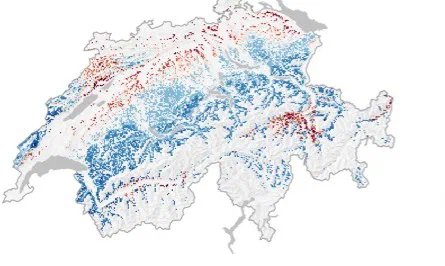
Many questions that society asks of ecology concern the future, for example how forests will grow in a changing climate. Because future conditions may lie outside anything observed so far, past correlations are a weak guide. Process-based models instead aim to describe the mechanisms of a system, such as growth, competition, mortality and the cycling of carbon and water, and to derive its behaviour from them. Their projections, however, are only as reliable as these mechanisms and their parameters, which are often uncertain. I work on forest and vegetation models and test their assumptions against inventory and monitoring data.
Key papers: Bugmann et al. 2019, Ecosphere; Käber et al. 2024, Geoscientific Model Development; Reyer et al. 2020, Earth System Science Data. Software: r3PG, rLPJGUESS, NUCOMBog, ProfoundData. Projects: BLIZ, REFORCE, PROFOUND, FORMASAM, CONNECT.
Model-data integration, simulation-based inference and Bayesian statistics
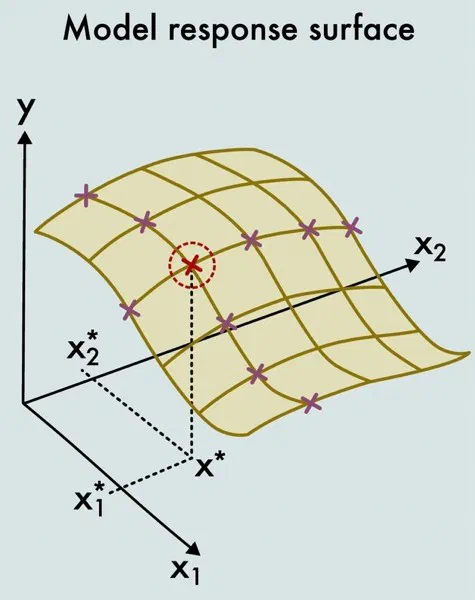
For prediction, a model is only as useful as its connection to data. Fitting a model to data, known as calibration, shows which parameter values are consistent with the observations and, given the model structure, how uncertain the predictions are. For simple statistical models this is routine. Many ecological models, however, are complex simulations that are costly to run. If they are also stochastic, the likelihood, the probability of the observations under the model, often cannot be calculated directly. Simulation-based methods such as approximate Bayesian computation still make calibration possible in this case. My group develops calibration methods for such models.
Key papers: Hartig et al. 2011, Ecology Letters; Hartig et al. 2012, Journal of Biogeography; Malchow & Hartig 2026, Ecology Letters. Software: BayesianTools. Projects: BLIZ, PROFOUND, DAAD, CONNECT.
Statistics, machine learning and deep learning in ecology
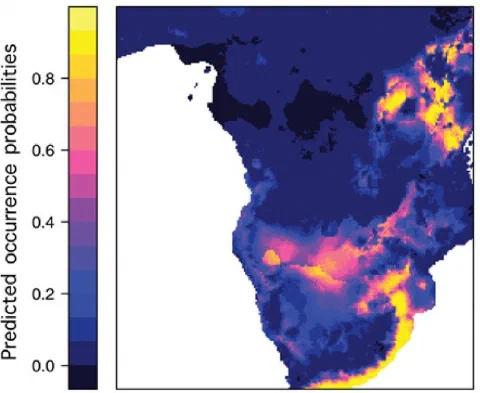
Almost every empirical conclusion in ecology rests on a statistical model, so an unsuitable method can turn good data into confident but wrong results. Ecological data make this a real risk: they are often structured in space, time, groups or phylogeny, violate standard distributional assumptions, and contain only what was detected, not everything that is present. At the same time, machine learning and deep learning open up new possibilities, especially for images, sounds and remote sensing, but the model that predicts best is not necessarily the one that reveals causes. Ecology therefore needs robust and accessible methods that combine predictive power with understanding causes and quantifying uncertainty. My own work focuses on residual diagnostics and on machine and deep learning for ecological inference.
Key papers: Roberts et al. 2017, Ecography; Dormann et al. 2018, Ecological Monographs; Pichler & Hartig 2023, Methods in Ecology and Evolution. Software: DHARMa, sjSDM, cito. Projects: BaySenseAI, DHARMa, sCOM.