The Recruitment Niche Predicts Plant Community Assembly Across a Hydrological Gradient Along Plowed and Undisturbed Transects in a Former Agricultural Wetland
Abstract
Seedling emergence in plant communities depends on the composition in the soil seed bank, in combination with species-specific responses to the environment. It is generally assumed that this juvenile transition, known as the recruitment niche, is a crucial filter that determines species’ distributions and plant community assemblies. The relative importance of this filter, however, has been widely debated. Empirical descriptions of the recruitment niche are scarce, as most field studies focus on environmental effects at later life stages. In this study, we examine the importance of the recruitment niche for predicting plant communities across a hydrological gradient in a disturbed and undisturbed area in Lake Schmiechen, Baden-Württemberg, Germany. We combine a seed bank experiment, measuring germination in water basins under standardized conditions and different water levels, with field observations of plant communities along a hydrological gradient in plowed and undisturbed transects in a former agricultural wetland. We find that hydrology consistently predicted plant community composition in both the germination experiment and in the field. The hydrological recruitment niches measured in the seed bank experiment correlated with the hydrological niche in both the plowed and undisturbed area, with slightly stronger correlation in the plowed area. We explain the latter by the fact that the seed bank experiment most closely resembles the plowed area, whereas succession and competitive interactions become more important in the undisturbed area. Our results support the view that the recruitment niche is an important driver of species composition, in both the plowed and undisturbed area. Recognizing the recruitment niche and the response of seeds within a seed bank to environmental gradients and anthropogenic disturbance is necessary to understand and predict future plant community composition.
What the paper shows and why it matters
(AI-generated)
Plant ecology mostly studies adult stages or assumes that life stages respond alike to the environment. The paper notes, however, that most plant mortality occurs at the seed-to-seedling transition. The conditions that allow a seed to germinate and establish are called the recruitment niche, one component of the broader regeneration niche (Grubb 1977). It has therefore been suggested that recruitment is a critical filter determining which species occur where, but its importance is debated and empirical descriptions are scarce. The problem the paper takes on is whether the recruitment niche, measured on its own under standardised conditions, predicts where species occur along an environmental gradient, with and without disturbance.
The study reports that species’ germination preferences for water level, measured in a controlled experiment, correspond to where those species grow along a water-level gradient in the field, and it reads this as support for germination conditions being an important filter of plant community composition. The test system is a former agricultural field at Lake Schmiechen, Germany, with one half ploughed in 1991 and 1996 and the other left undisturbed. Soil from the site was kept in pots under six water regimes, from dry to flooded, and 27 of 34 species showed a significant response, each giving a germination optimum. Vegetation surveys between 1990 and 1999 gave each species’ position along the field’s water-level gradient. The two correlated: the rank correlation was 0.76 in the ploughed half (18 species) and 0.59 in the undisturbed half (20 species). The paper explains the slightly stronger match in the ploughed half by the experiment’s mixed soil resembling ploughed ground, whereas succession and competition weigh more where the soil was undisturbed. It reports this difference as significant for one of the two measures it compares.
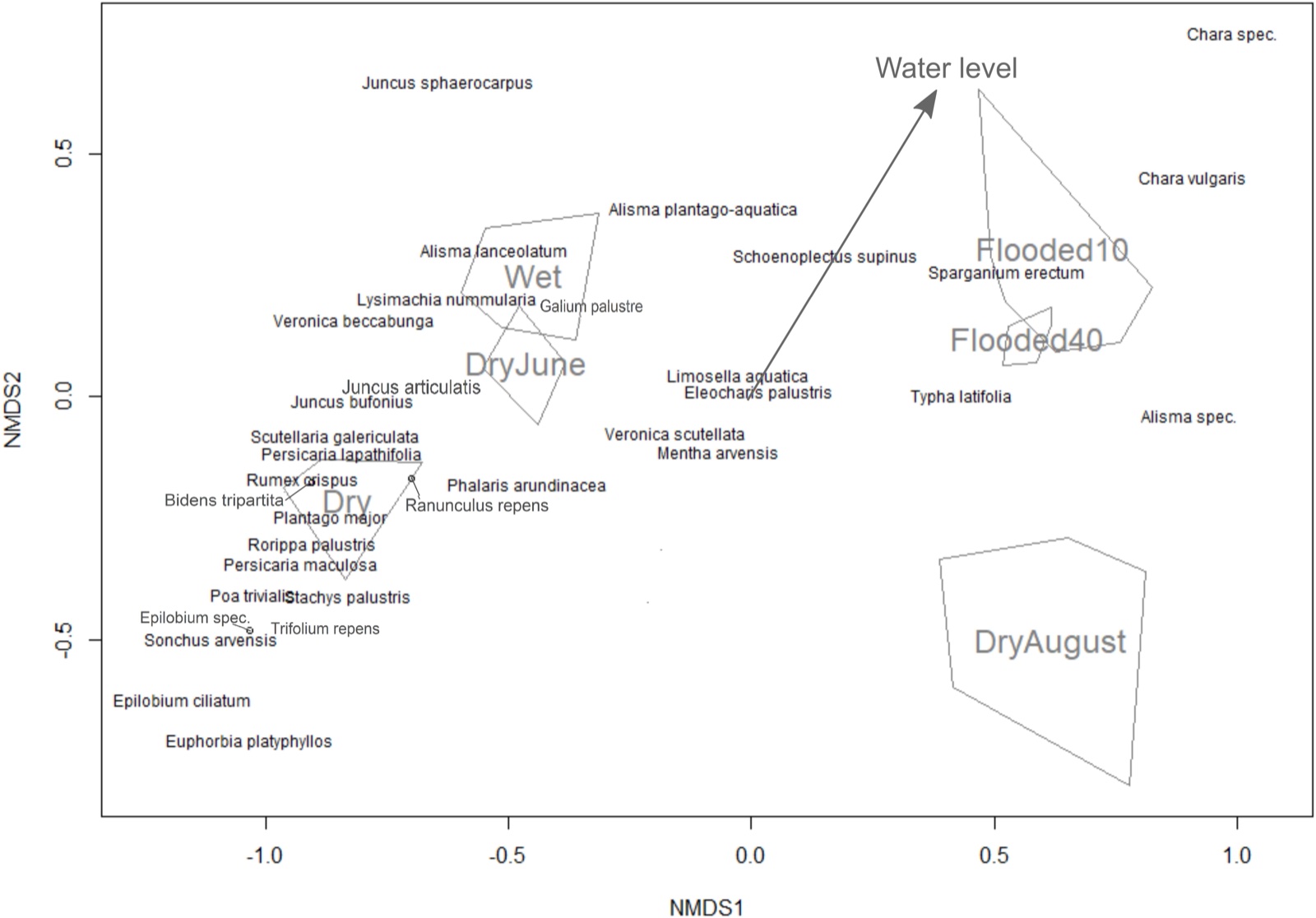
The paper states that the results are consistent with two readings: recruitment dominates community composition along the gradient, or recruitment and adult niches are very similar in these wetland communities. Limits remain: only about 40% of the species seen in the field germinated in the experiment, and the evidence comes from one site. The paper argues that recognising the recruitment niche and disturbance is needed to predict community composition, and that this may improve restoration decisions and projections under environmental change.
References
- Grubb (1977). The maintenance of species‐richness in plant communities: the importance of the regeneration niche. Biological Reviews 52, 107–145. doi:10.1111/j.1469-185x.1977.tb01347.x