Climate and parameter sensitivity and induced uncertainties in carbon stock projections for European forests (using LPJ-GUESS 4.0)
Abstract
Understanding uncertainties and sensitivities of projected ecosystem dynamics under environmental change is of immense value for research and climate change policy. Here, we analyze sensitivities (change in model outputs per unit change in inputs) and uncertainties (changes in model outputs scaled to uncertainty in inputs) of vegetation dynamics under climate change, projected by a state-of-the-art dynamic vegetation model (LPJ-GUESS v4.0) across European forests (the species Picea abies, Fagus sylvatica and Pinus sylvestris), considering uncertainties of both model parameters and environmental drivers. We find that projected forest carbon fluxes are most sensitive to photosynthesis-, water-, and mortality-related parameters, while predictive uncertainties are dominantly induced by environmental drivers and parameters related to water and mortality. The importance of environmental drivers for predictive uncertainty increases with increasing temperature. Moreover, most of the interactions of model inputs (environmental drivers and parameters) are between environmental drivers themselves or between parameters and environmental drivers. In conclusion, our study highlights the importance of environmental drivers not only as contributors to predictive uncertainty in their own right but also as modifiers of sensitivities and thus uncertainties in other ecosystem processes. Reducing uncertainty in mortality-related processes and accounting for environmental influence on processes should therefore be a focus in further model development.
What the paper shows and why it matters
(AI-generated)
Dynamic vegetation models project forest carbon under climate change but disagree, and knowing which inputs cause the uncertainty is valuable for interpreting projections and for deciding where to improve a model. Sensitivity analysis measures how an output responds to an input; uncertainty analysis asks how much of the output’s spread each input causes. Both are rarely applied to complex models. Earlier analyses of the LPJ family of models, to which LPJ-GUESS belongs (Zaehle et al. 2005; Pappas et al. 2013), varied parameters at a few chosen sites and ranked them, a tractable approach; other studies varied only environmental drivers. Treating the two separately assumes that a parameter matters equally in every climate. This is the assumption the paper tests.
The paper argues, from a joint sensitivity and uncertainty analysis of the vegetation model LPJ-GUESS 4.0 for European forests, that the importance of a model’s processes depends on the environment, so parameters and environmental drivers must be analysed together. The model was run about 16 million times at 200 sites for beech, pine and spruce, varying 33 parameters (ranges from expert elicitation and the literature) and five drivers (temperature, precipitation, solar radiation, CO2, nitrogen deposition). For the assumed input ranges, environmental drivers caused about as much of the uncertainty in carbon as all parameters together; for standing biomass their share averaged around 45%. Among parameters, those for tree mortality and photosynthesis contributed most to the uncertainty in standing biomass; water-related parameters were prominent for other carbon outputs. The share caused by drivers rose with mean annual temperature, while that of parameters for tree structure and nitrogen fell, and most interactions between inputs involved drivers.
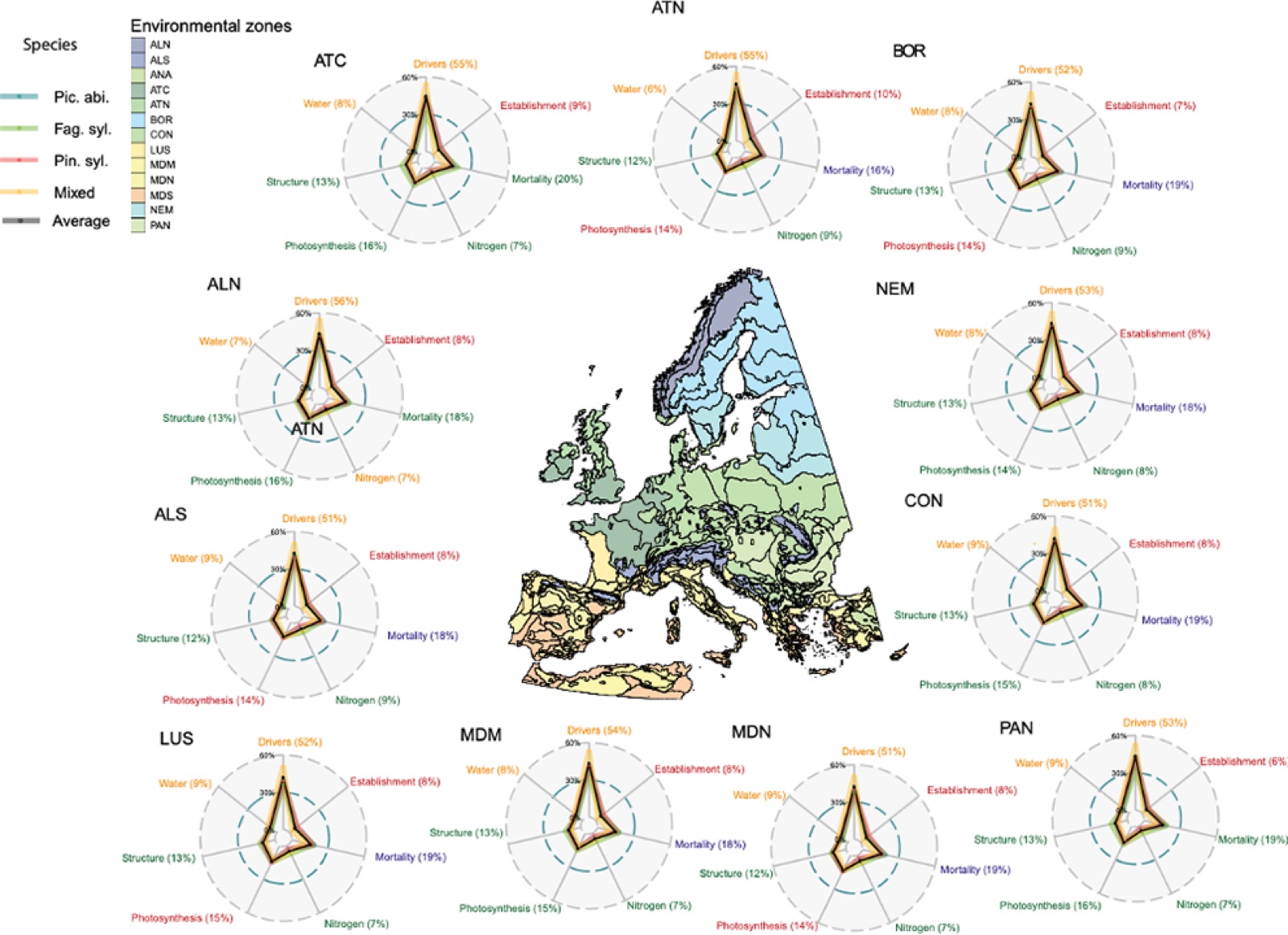
A parameter’s importance is not a fixed property of the model, and analyses at a single site or scenario may not carry over to other climates. From its ranking of parameters, the paper points to mortality as a priority for model development, and to fitting the model to data region by region, for the parameters that contribute most uncertainty there. It notes that much driver uncertainty stems from future emissions and is hard to reduce. A later study of an extended version of the model (Meyer et al. 2025) cites the paper for the rarity of such analyses and follows its choice of outputs.
References
- Zaehle et al. (2005). Effects of parameter uncertainties on the modeling of terrestrial biosphere dynamics. Global Biogeochemical Cycles 19, 2004GB002395. doi:10.1029/2004gb002395
- Pappas et al. (2013). Sensitivity analysis of a process‐based ecosystem model: Pinpointing parameterization and structural issues. Journal of Geophysical Research: Biogeosciences 118, 505–528. doi:10.1002/jgrg.20035
- Meyer et al. (2025). Simulating the drought response of European tree species with the dynamic vegetation model LPJ-GUESS (v4.1, 97c552c5). Geoscientific Model Development 18, 4643–4666. doi:10.5194/gmd-18-4643-2025