Calibration, Sensitivity and Uncertainty Analysis of Complex Ecological Models—A Review
Abstract
Ecologists increasingly use complex models to predict and understand ecological systems and their responses to external drivers or anthropogenic pressures. An ongoing challenge in this context is quantifying and reducing uncertainty in model inputs, parameters and structure and understanding their implications for model predictions. Three major methodological fields have emerged in this context: sensitivity analysis, uncertainty analysis and model inversion or calibration. While these three methods are an integral part of any modelling or forecasting process, the corresponding literature is often scattered, and distinct terminology and definitions are used in different methodological and scientific contexts. Here, we review and connect these three fields and discuss best practices for their practical implementation with a focus on complex ecological models. We classify relevant types of uncertainty, discuss the complementary roles of sensitivity and uncertainty analyses, give an overview of available calibration methods and emphasize the importance of effective communication of uncertainty. We conclude that using state‐of‐the‐art methods for understanding model behaviour as well as consistently accounting for all uncertainties is essential for correctly understanding model predictions and thus forms the basis for a responsible use of models in ecological decision making.
What the paper shows and why it matters
(AI-generated)
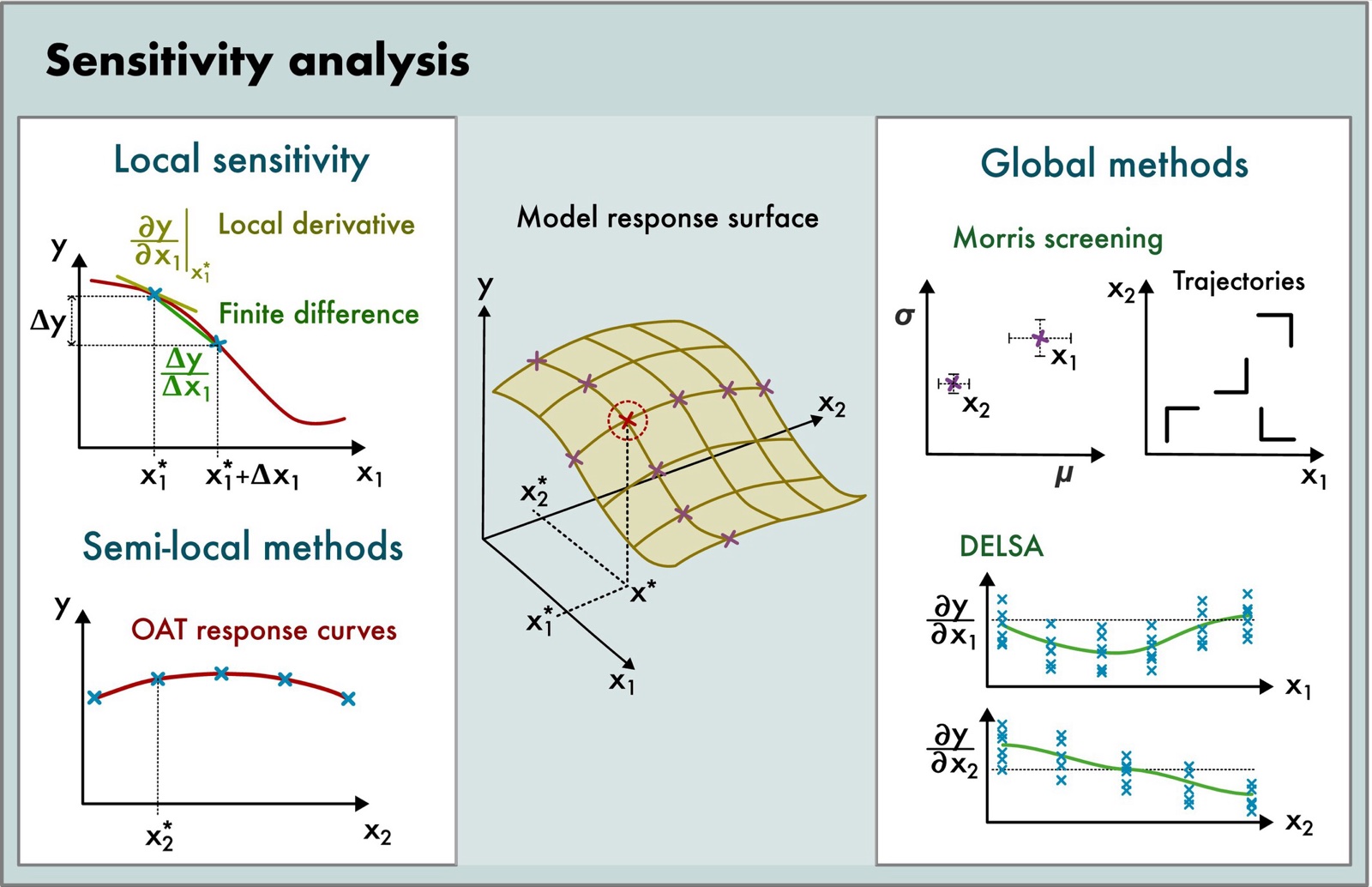
Ecologists increasingly use complex models to predict ecosystems and guide management, and quantifying and reducing the uncertainty in such models is a key challenge. Three groups of methods address it. Sensitivity analysis measures how strongly a model’s output responds to changes in its inputs; uncertainty analysis traces how uncertain inputs become uncertain predictions; and model inversion or calibration fits a model to data to narrow down its parameters. Each has its own literature and terminology, and existing reviews mostly cover one method or one type of model. Existing guidance has a reasonable core, for example in favouring global sensitivity analysis, which varies all inputs together and so captures interactions (Saltelli et al. 2006). What is missing is a view in which the three are used together.
The paper presents sensitivity analysis, uncertainty analysis and model calibration, the three methods for handling uncertainty in complex ecological models, as one framework to be used together. Looking forward, from inputs to predictions, the uncertainty of a prediction depends on how uncertain each input is and how sensitive the model is to it. Looking backward, from data to inputs (calibration), data can most easily reduce uncertainty in the inputs and components to which the prediction is sensitive. A one-at-a-time analysis, changing one input at a time, is advised early in a project because it gives visual feedback on model behaviour, explicitly against guidance that only global methods should be used; a global analysis follows. Uncertainties should usually be expressed as probability distributions. Full Bayesian calibration is called the gold standard. Informal methods, such as generalised likelihood uncertainty estimation (GLUE) or pattern-oriented modelling, may be more robust against structural error (errors in the model’s equations rather than its parameters), but give no probabilistic uncertainty. The paper reports no new data; published studies serve as illustrations.
The paper concludes that treating all relevant uncertainties consistently is central to the credibility of models used for management decisions, and that applying even one of the three methods gives valuable insight into a project’s uncertainty. Predictions should therefore be shown with credible intervals (parameter uncertainty), prediction intervals (which add observation error), and marked regions where the model interpolates within the range of the data or extrapolates beyond it. The paper notes that many recommendations rest on practical experience rather than systematic comparisons.
References
- Saltelli et al. (2006). Sensitivity analysis practices: Strategies for model-based inference. Reliability Engineering & System Safety 91, 1109–1125. doi:10.1016/j.ress.2005.11.014